

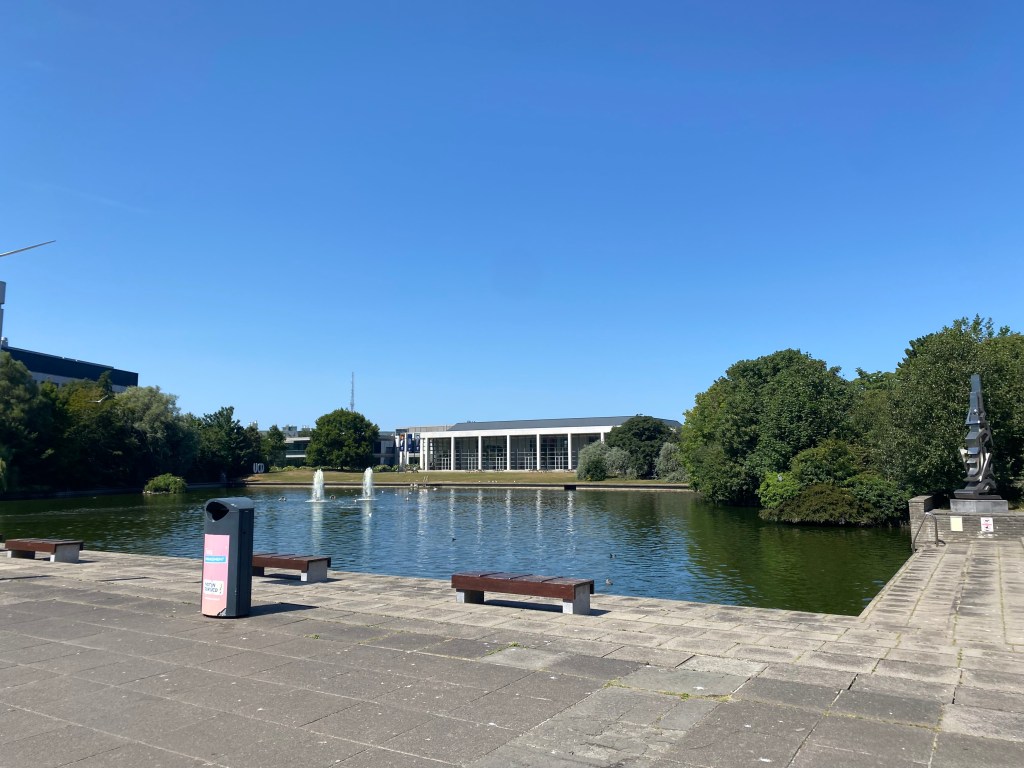
Note: This blog post is written by CAMP Lab PhD student Olivia DiPrinzio, who attended the International Environmental Modeling & Software Society (iEMSs) conference in Dublin, Ireland, in July 2026.
This past July, the 13th bi-annual International Environmental Modeling and Software (iEMSs) conference took place at University College Dublin, Dublin, Ireland. Established in 2002, the conference draws environmental modelers from all topical and modeling specialty backgrounds to discuss the field’s emerging horizons and persistent challenges. Supported by my department, college alumni board, and the CAMP lab, my participation at iEMSs provided me with a diverse, welcoming introduction to academic conferences. With a focus on climate risk perceptions and policy, my practical modeling experience has been limited to date, as I continue to develop key concepts for my first agent-based model (ABM) on the effect of climate policies on Nepali farmers’ livelihoods. Despite this limited understanding, iEMSs was the perfect opportunity to not only become more familiar with the broader environmental modeling network and their work but also meet and learn from the ABM community’s intellectual pioneers.
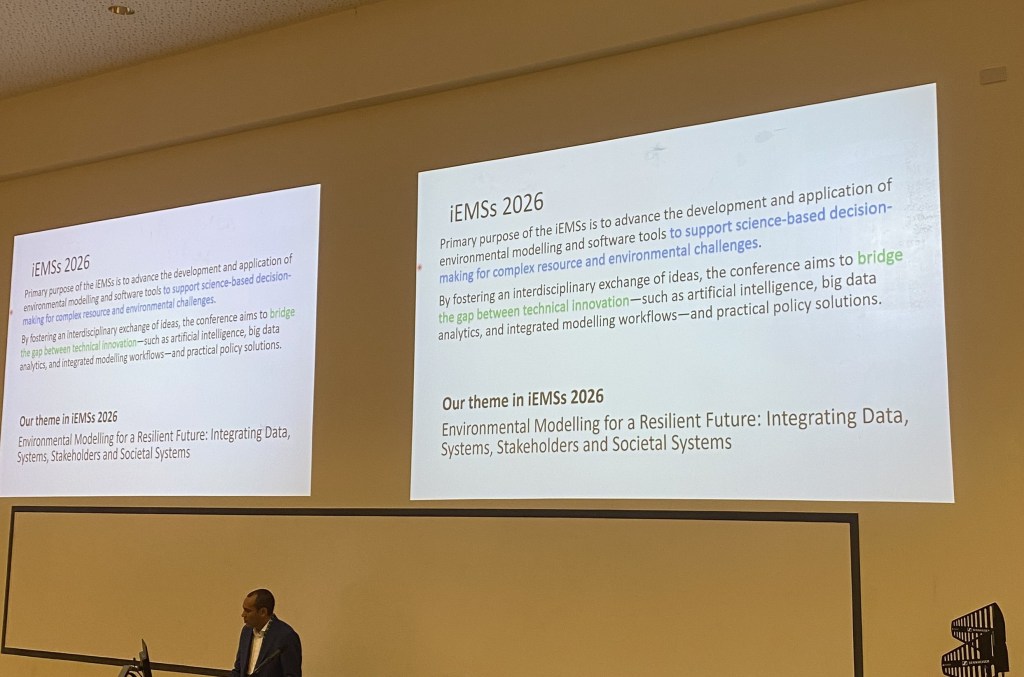
The conference was, personally, an eye-opener to the sheer variety of model types and applications available, including opportunities for cross-model comparisons. Everyone from Structural Equation Modelers to Graph Theorists attended, and the topics were broader, from coastal tourism predictions to resource market feedback. Yet, two common themes ran through the proceedings. First, AI use was prominent, particularly using agentic AI systems throughout the modeling process. While intended to standardize workflows and automate modelling components, agentic AI was still reported as a potential costly time sink due to requiring significant researcher review, highlighting a current challenge for the field. Second, a sizable group of presenters shared work that integrated participatory methodologies. Community and/or user feedback appeared at various stages of the modeling process for several projects, including model development and validation. While regarded as a somewhat difficult feat, the presenters demonstrated a path forward for increased community input in environmental modeling—a concept gaining popularity in environmental spaces for the acknowledged value of local, traditional, and Indigenous knowledge.
With these overarching themes underpinning the conference, individual sessions explored a diverse array of topics. After three and a half days of presentations, three particularly stood out. First, Dr. Ann van Griensven explored the potential of merging models with UNESCO’s climate risk-informed decision analysis (CRIDA). Framing this integration as a participatory approach, Dr. van Griensven presented a project that utilized the combined method to address stakeholder-identified issues through developed vulnerability assessments. Second, Ph.D. candidate Valentina Antonaccio Guedes presented her migration ABM based on Dr. Hein de Haas’s aspiration-capabilities framework. Her presentation pulled back the curtain on ABMs, as she shared the equations and decision rules governing her complex yet (remarkably!) generalizable model. Finally, there was Dr. Andrew Bell’s presentation on the Purpose-Assumptions-Validity-Exploration (PAVE) modeling cycle. As a budding modeler myself, Dr. Bell and his collaborators’ framework offered an alternative perspective that saw modelers as “the knowledge broker and science communicator,” addressing a significant challenge faced by the modeling community today.
Looking ahead, clear challenges and areas for excitement exist. As discussed above, a significant challenge remains modelers’ (and the entire scientific community’s) ability to bridge the gap between their work and audience(s) through effective communication. Scientists must continue to expand their communication capabilities, collaborate constructively with policymakers, and make science accessible. Alternatively, an area for excitement, at least from my perspective, is an emerging method known as Cross Impact Balances (CIB). As calls continue for greater recognition of qualitative or mixed data, CIB offers a means for systematically processing such information so that it can then be integrated into a variety of models. While CIB caught my interest due to its compatibility with ABMs as input for agents’ behavior, it has also been used in work on deep uncertainty, policy mix development, and even in serious games (a special interest of mine)! As it is with any scientific field, there are still problems to address and new spaces to explore, which I felt iEMSs did a good job of showcasing. This conference was a wonderful introduction to the modeling community and has certainly given me a lot to think about as I dive deeper into my journey with agent-based modeling!
 CAMP lab
Leave a comment