

The CAMP Lab has a new paper published! In “Aspirations in a Warming World: Modeling Migration and Education Decisions under Climate Risk in Senegal“, we investigate how climate change is likely to affect migration patterns through its impacts on the types of jobs and futures that people aspire to. This is an especially policy-relevant question in Senegal, where successive governments have sought to better match educational opportunities with the desires of the country’s large youth population.
In a collaboration with nine wonderful co-authors across several disciplines and countries, we adapt an agent-based model of livelihood decision-making that was initially developed by Cornell Professor Andrew Bell (Nic’s post-doc mentor!). Based on insights gained through a series of participatory modelling workshops with academics and migration professionals, we extended the model to allow agents to evaluate different types of livelihood pathways they might pursue in the future, and assess the types of human capital investments they would need to make now in order to achieve those. We then developed scenarios for two of the region’s major climate risks — drought in the interior Sahel, and sea level rise along the coastal Atlantic cities — to assess how those aspirations and near-term investments might change with evolving climate risks.
We found several interesting results:
- Accounting for livelihood aspirations in our model substantially expands the range of climate adaptation behavior we can capture, increasing the projected migration rate by 45 percent and the projected post-secondary educational rate by 110 percent over a 25-year time period, compared to a reference case without aspirations.
- Local migration opportunities and access to vocational schools are especially important forms of human capital “shock absorbers”. Agents recently affected by climate-induced livelihood losses especially rely on them to fulfill their livelihood aspirations.
- Contrary to many prevailing narratives, we don’t project that climate change will substantially increase the overall amount of migration over decadal time scales. However, we do find that different climate shocks may change the timing and location of that migration.
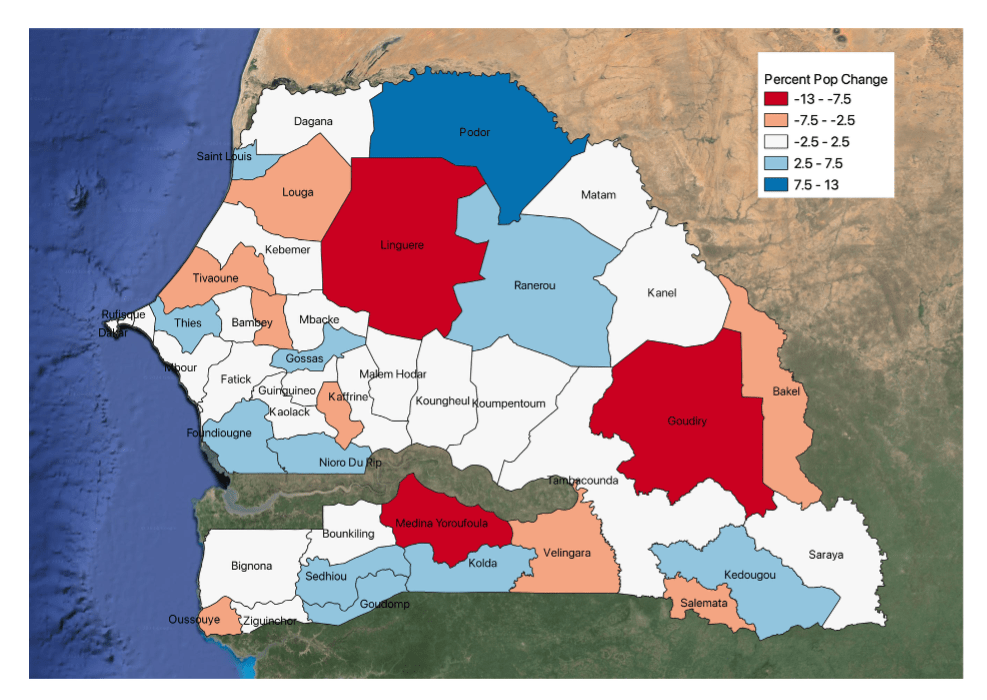
- Regions near especially climate-vulnerable areas are likely to see population increases, as droughts and sea level rise limit the ability of people to migrate long distances to fulfill aspirations. This is especially important for regions in Senegal’s interior, which haven’t traditionally been migrant destinations but may increasingly become so as climate change becomes more severe (see image above, which shows the long-term population change attributable to a 5-year drought along the interior Senegal River Valley, relative to a no-drought reference case).
Now that we’ve developed the ability to model dynamic livelihood aspirations, it opens up all kinds of possibilities to investigate more nuanced behavioral responses to different policy, environmental, and economic futures. We see particular relevance to policy questions regarding how the types, locations, and timings of human capital infrastructure can build climate resilience. If you have a case study or research question relating to this theme, we’d love to collaborate! Please feel free to get in touch with Nic at nmc6187 [at] psu.edu.


Leave a Reply