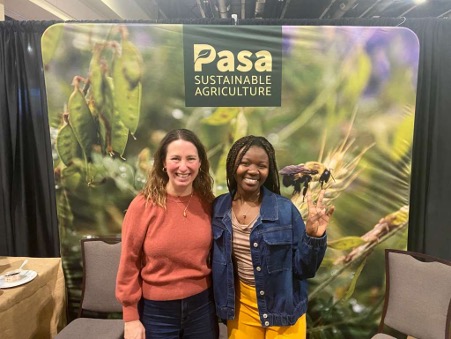


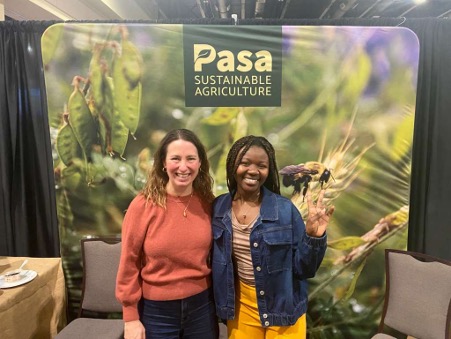
Note: This blog post is written by CAMP Lab PhD student Martina Adjei-Yeboah, who attended the PASA 2026 Sustainable Agriculture Conference in Lancaster, Pennsylvania.
Attending the PASA Sustainable Agriculture Conference in Lancaster was a very good experience for me, not just as a young researcher, but as someone who cares about what sustainable agriculture looks like in practice and in community. The conference was structured around multiple sessions running at the same time, which meant participants could choose the discussions that resonated most with their interests and needs. This flexibility alone made the conference feel intentional and inclusive, especially for farmers. The sessions were practical, grounded, and tailored to what farmers actually do whether that meant learning how to reach buyers through websites and media platforms, understanding soil health and microbes, navigating land buying and leasing, or learning how to present a strong case when applying for loans and grants. Agriculture is capital-intensive, and many sessions acknowledged this reality openly, encouraging farmers to build financial literacy, understand balance sheets, and seek training where needed. The conference treated it as the complex, demanding profession that it truly is.
One of the beautiful things I saw was the strong presence of women farmers. In many agricultural spaces particularly in Ghana, where I come from, farming spaces are often dominated by men, even though women play critical roles behind the scenes. At PASA, however, there was a visible balance between male and female farmers, and more importantly, women were actively participating in every aspect of farming. Conversations I had with some of them made it clear that they were not sidelined or restricted from accessing resources. While access did not always mean perfection or complete training, women were present, engaged, and recognized as full participants in the agricultural system.
Food also played a meaningful role at the conference, something I didn’t expect to appreciate as much as I did. While I am still adjusting to American food, I genuinely enjoyed several meals, especially the fresh organic yogurt served with homemade granola that was noticeably low in sugar, as well as the mashed potatoes and beans. What made these meals special, however, was learning that the food served at the conference came directly from farmers. There was something powerful about eating food grown by the very people the conference was designed to support. It reinforced the connection between agriculture, community, and nourishment. Another powerful takeaway was the sense of resilience rooted in community. There were honest conversations about funding cuts, particularly reductions in support from institutions like the USDA. While many farmers expressed disappointment and understandably so, what I undeniably loved was that funding challenges did not dismantle their sense of community. Even when financial support fell short, the relationships remained. Farmers leaned on one another, shared experiences, and stayed connected. This for me showed the strength of community-based systems. while funding matters, people matter just as much. Resilience, I learned, lives between people.
The conference also challenged a common myth about farmers that they lack formal education or technical expertise. At PASA, this could not have been further from the truth. Many farmers originally came from engineering, scientific, and other technically demanding fields. They chose farming not because they lacked options, but because they were driven by passion. Choosing farming meant embracing uncertainty, weather risks, physical labor, and long days in the field regardless of conditions. Seeing people willingly step into such risk with intention and commitment gave me a renewed respect for farmers and the work they do.
As a young researcher and student, I found the conference valuable because it reminded me that sustainable agriculture is not just about policies, grants, or research outputs; it is about people, systems, and relationships. The emphasis on education, collaboration, communication pathways, and long-term structures (rather than short-term funding alone) offered lessons that extend far beyond Lancaster. Leaving the PASA Conference, I found myself reflecting on what could be done differently or better in contexts like Ghana. Seeing women fully engaged, farmers supported through tailored education, food systems that feed back into the community, and resilience built through connection made me hopeful. It showed me that sustainability is not only about land or yields, but about equity, inclusion, and shared purpose.
Overall, the PASA Sustainable Agriculture Conference was not just informative, it was grounding. It reaffirmed why agriculture, despite its risks, continues to attract passionate, capable people. And it reminded me that when farming is supported by strong communities and thoughtful systems, it becomes more than a livelihood, it becomes a collective commitment to the future.
 CAMP lab
Leave a comment