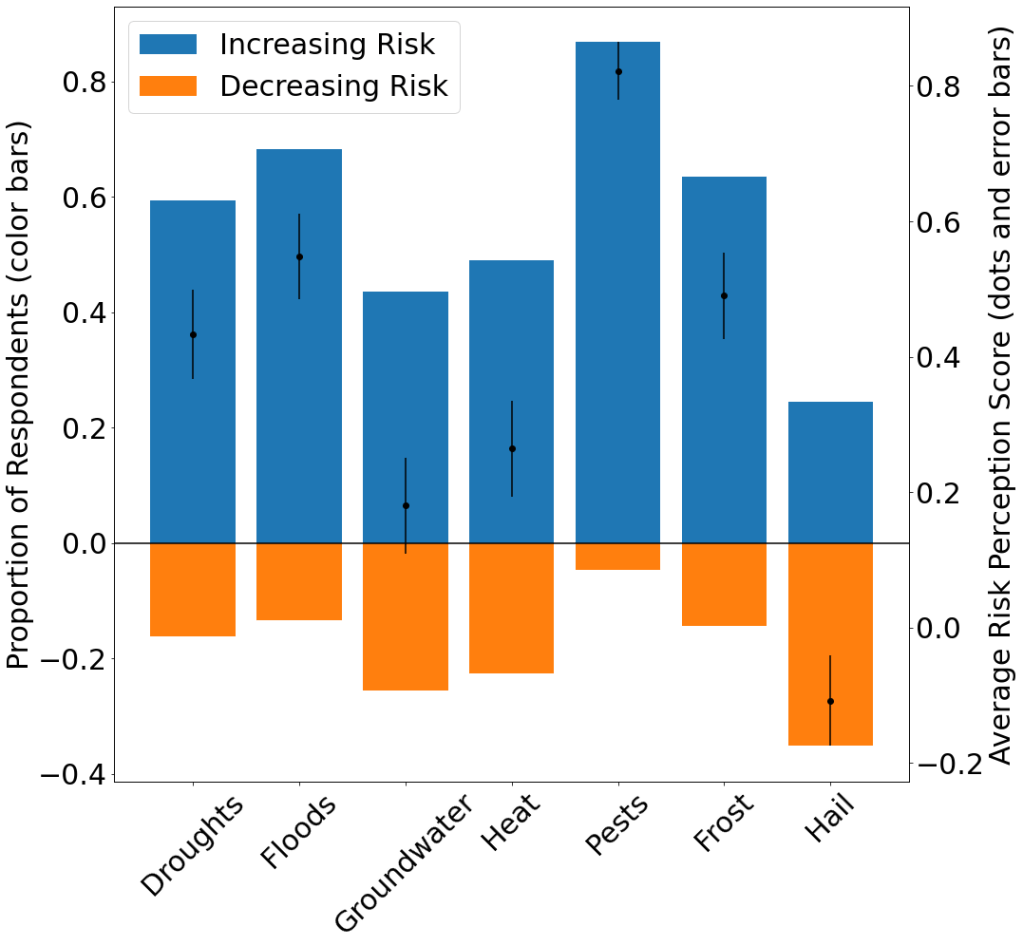


The CAMP Lab has a new paper out! In Retrenchment under Climate-Driven Risks in Subsistence Farming Communities, published in May 2025 in the journal Population and Environment, we investigate how Nepali farmers form perceptions about climate risks, and how those perceptions affect livelihood choices around farming, off-farm employment, and migration. To do this, we collaborated with the Institute for Social and Environmental Research – Nepal to design and implement a survey of 500 households in the Chitwan Valley, one of Nepal’s main agricultural regions. We found three main results:
- While farmers had varied understandings of the term “climate change”, most Nepali farmers perceive “long-term weather risks” to be one of the most significant factors affecting their economic success.
- Perceptions of high climate risk are associated with beliefs that farming is also risky, which we expected given the close relationship between weather and farming. But we were surprised that perceptions of high climate risks were even more strongly associated with elevated risks of other livelihoods, including working off the farm and migrating internationally.
- Farmers generally maintain diversified income streams, including money from crops, livestock, working off the farm, and remittances (i.e., money sent from family members living abroad). However, farmers who experienced a drought or flood were more likely to increase their reliance on farming income in subsequent years, even though climate change is making this livelihood riskier. This is true for both the poorest and wealthiest farmers, suggesting there might be both financial and psychological drivers of this change.
This study suggests that if we just focus on risks to crops, our climate information services may not fully capture all the facets of climate risks that matter to farmers. More holistic services that mitigate climate risks to other livelihoods pursued by rural households can help increase farmers’ agency in responding to increasing climate-driven hazards.
To read more about the study, please consult the paper and a nice write-up by Penn State communications. We’re already at work planning following-up studies with partners in Nepal, so stay tuned for more updates!
 CAMP lab
Leave a comment